
Running a Sex Offender Check in Mohave County
The main public channel is the Arizona DPS OffenderWatch registry. It supports both person and place searches. A name search is useful when enough identifiers are known to distinguish one person from another. An address search is better for community awareness around a home, school route, or other place. Results reflect the published registry, not every contact with police. Compare the photo, aliases, physical description, address, offense summary, and registration status before drawing a conclusion.
Mohave County adds a local layer through the sheriff's map and email alerts. The state registry supplies the statewide search, while the county tool focuses on nearby published locations and linked partner-agency data. Neither replaces the original judgment or docket. When the precise conviction, sentence, or later court order matters, consult the court named in the registry information and use the criminal case record.
Mohave County OffenderWatch Alerts
The Mohave County Sheriff's OffenderWatch page explains how residents can view a map and register an address for email notices. The tool can monitor an address important to the user and send notice when a published offender registers within the selected area. Partner databases are linked for a regional display, which matters in a county with long travel corridors and communities near state and county lines.
The sheriff's page below is the source for the local map and alert process.
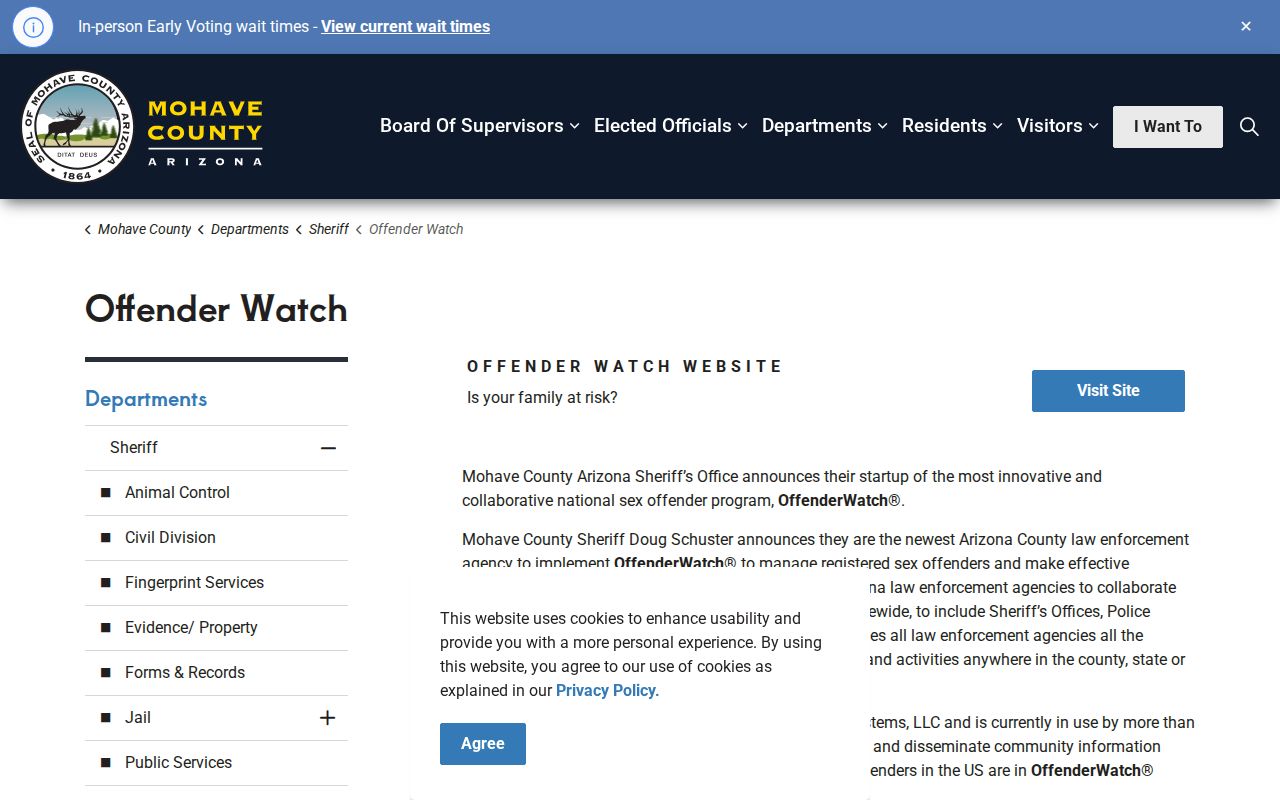
Its address-alert option turns a one-time Mohave County registry search into ongoing awareness without requiring the user to repeat the same search each day. Check the record again after a move or status change because an email alert is a notice, not a permanent profile copy.
Note: An alert reports a registry change near the watched address; it does not announce a new conviction or prove unlawful conduct.
Searching the Arizona DPS OffenderWatch Registry
Choose the search path that fits the known facts. Address searches use location and radius details. Name searches accept partial matches. The interface also provides a separate non-compliant search and an exact-match internet name or email search. Broad results need careful review because names, aliases, and cities may overlap.
- Open Arizona DPS OffenderWatch and review its conditions of use.
- Enter a full address for a local area check, or use the name fields for a person search.
- Review the map or result list and compare identifying fields. Do not rely on a name alone.
- Open the matching profile, read the offense and status, and verify a legal detail with the originating court when needed.
| Field label | Type | Required | Use |
|---|---|---|---|
| Address, City, State, ZIP | Text and select | For area search | Find published home or secondary addresses within a radius |
| Last Name, First Name | Text | No | Returns partial name and alias matches |
| City | Text | No | Runs a city-only partial-match search |
| Non-Compliant Offenders | Separate link | No | Opens the non-compliant result path |
| Internet Name or Email | Text | No | Requires an exact match |
| Register for Email Alerts | Link | No | Watches a selected radius around an address |
Use home and secondary address filters deliberately. The same registrant may have more than one published location, while an internet-identifier search succeeds only on an exact match. If a broad partial-name search returns several people, narrow the result with the profile's photo, description, and location instead of assuming the first row is correct.
Mohave Searches Across State Lines
The Arizona tool is the best first stop for a Mohave County address. The Dru Sjodin National Sex Offender Public Website adds a cross-state layer when a person moved, uses an out-of-state address, or lives near a border. NSOPW searches participating jurisdictions from one official federal interface. It does not replace Arizona's profile details or Mohave County alerts.
The national search interface shown below helps users broaden a registry check without turning to a private people-search service.
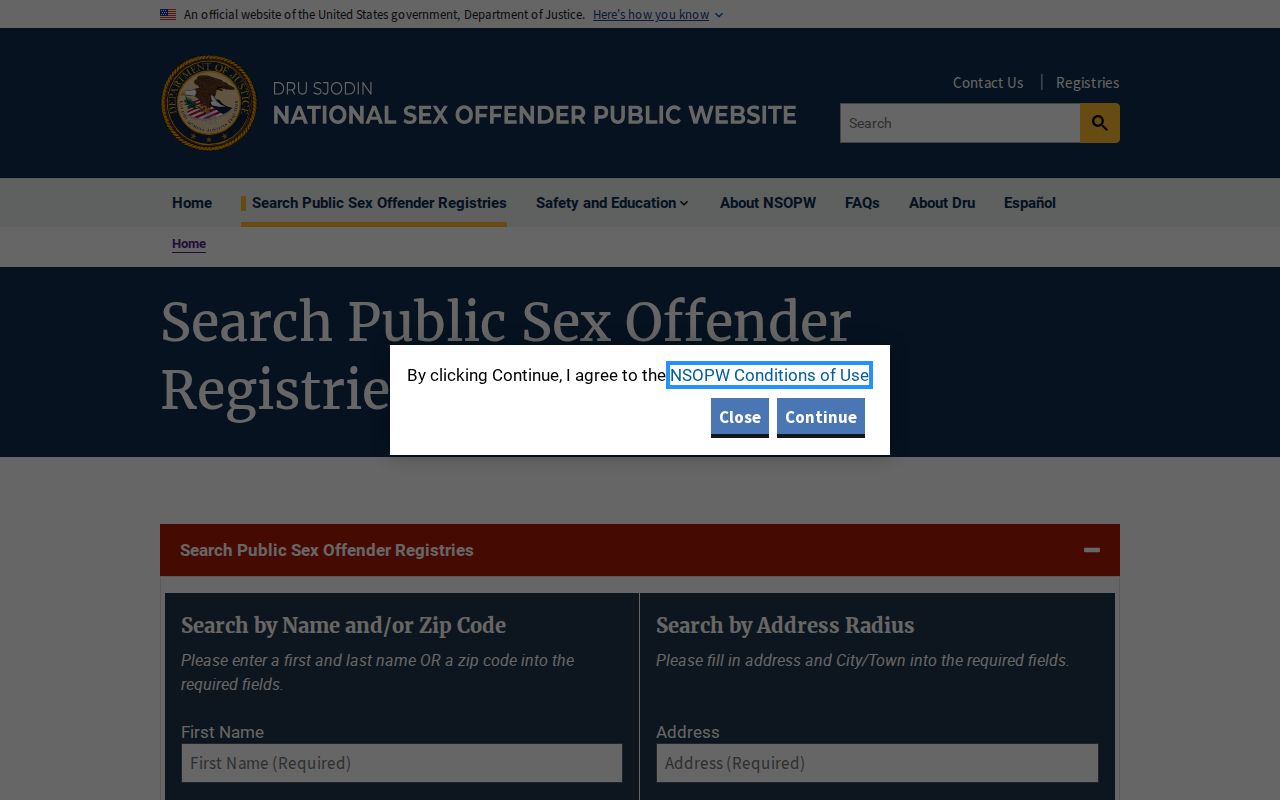
Return to Arizona DPS or the responsible sheriff for current local registration details after a national result points to Arizona.
What a Registry Profile Shows
A public profile is an awareness record. It combines identification, published location, offense, and registration details. It does not show every motion, hearing, plea, or sentencing document from the criminal court file. Vehicle and online-identifier information may be collected under Arizona law, though the public display can vary by record and lawful publication rules.
| Name and Aliases | Published legal names and alternate names used to match the registrant. |
|---|---|
| Photo and Description | Photo plus available sex, race, height, weight, hair, eye, and age details. |
| Registered Address | Published home or secondary location and map position. |
| Offense Information | Conviction or criminal background summary, including offense information. |
| Level | Arizona risk level tied to the scope of community notification. |
| Registration Status | Compliance information, including a non-compliant designation when published. |
Read each field in context. A mapped location may be a secondary address, and a registry level describes notification practice rather than a new charge. The originating court file remains the source for the disposition and sentence.
Mohave County Sheriff Registration
A.R.S. section 13-3821 requires covered people to register with the sheriff of the county within the statutory timeframes. Mohave County registration routes through the Mohave County Sheriff's Office at 600 West Beale Street, Kingman, AZ 86401, phone 928-753-0753. The law calls for names, fingerprints, a photo, residence details, online identifiers, certain vehicle information, and annual birth-month verification.
The Arizona registration statute is reproduced in the source image below.
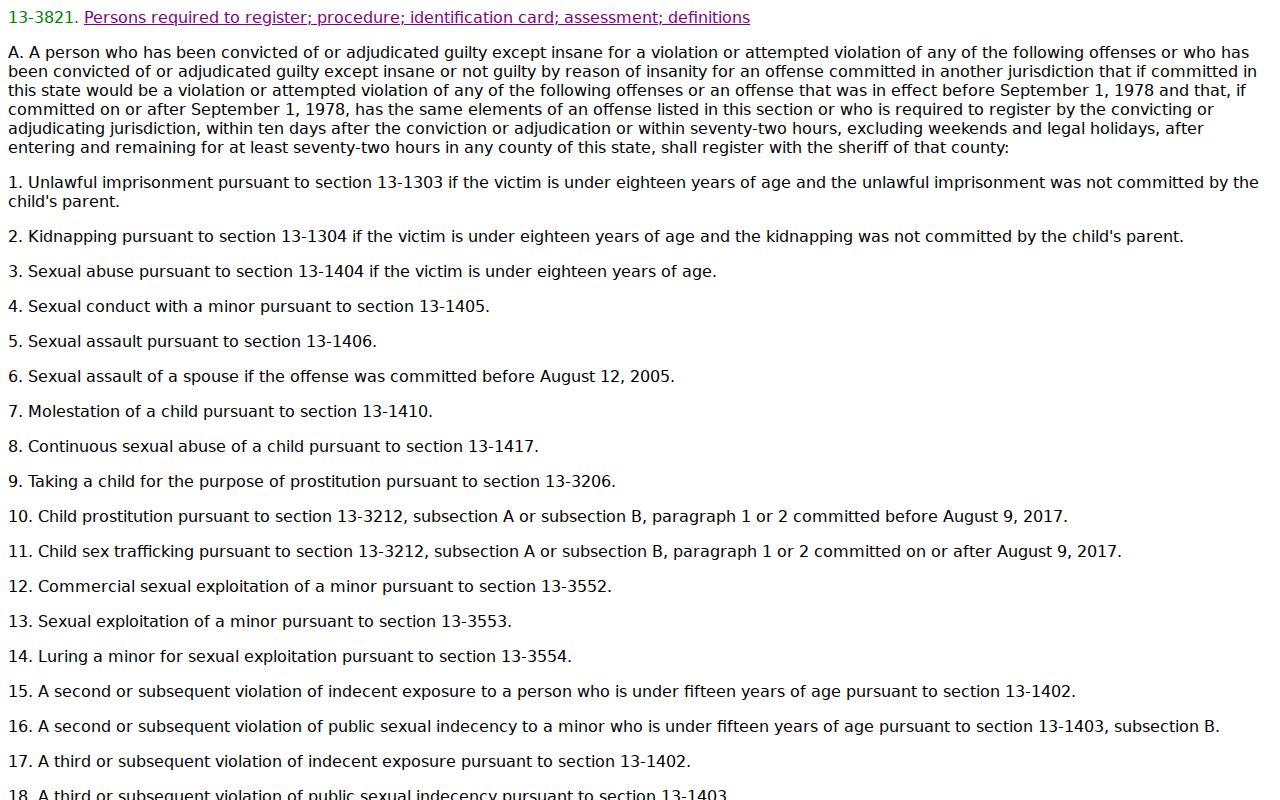
Those collected fields explain why a registry profile can contain details that do not appear in a basic court-search result.
Note: Registration is an official sheriff process; public searches and email alerts are separate awareness tools for residents.
Registration Requirements and Levels in Arizona
Arizona uses risk levels to guide community notification. Level 1 information may have limited distribution unless the offense is a dangerous crime against children. Levels 2 and 3 carry broader community notice and public visibility. Registration length depends on the offense and any applicable court relief, not on risk level alone. Annual verification applies under the registration statute unless the duty ends.
| Category | Public effect | Duration or verification |
|---|---|---|
| Level 1, other offense | Local law enforcement keeps information with limited dissemination | Annual verification unless duty ends |
| Level 1, dangerous crime against children | Community notification applies | Statutory duty; some juvenile duties end at age 25 |
| Level 2 | Community notice and public registry visibility | Annual verification and local notification |
| Level 3 | Broadest community notification posture | Annual verification and broad notice |
| Certain minor kidnapping or unlawful imprisonment cases | Registration applies under the listed conditions | Ten years after release, supervision, and restitution completion |
| Most listed sex offenses or a prior registration offense | Registry and notification depend on level | Often lifetime unless a court terminates or suspends duty |
Risk level and registration term answer different questions. The level controls how widely local agencies notify the public. The offense, prior registration history, age, statutory category, and any later court order control how long the duty lasts. Confirm a specific person's term through the responsible sheriff or court rather than trying to infer it from the level alone.
Mohave County Community Notification
A.R.S. section 13-3825 governs the community-notification path. Depending on the level and offense, notice may reach neighborhoods, schools, community groups, and media. Level 1 offenders who did not commit a dangerous crime against children generally remain in a more limited law-enforcement distribution category. That difference explains why a person known to law enforcement may not appear with the same broad visibility as a Level 2 or Level 3 registrant.
The official community-notification statute shown below defines the state framework used by DPS, the sheriff, and local police.
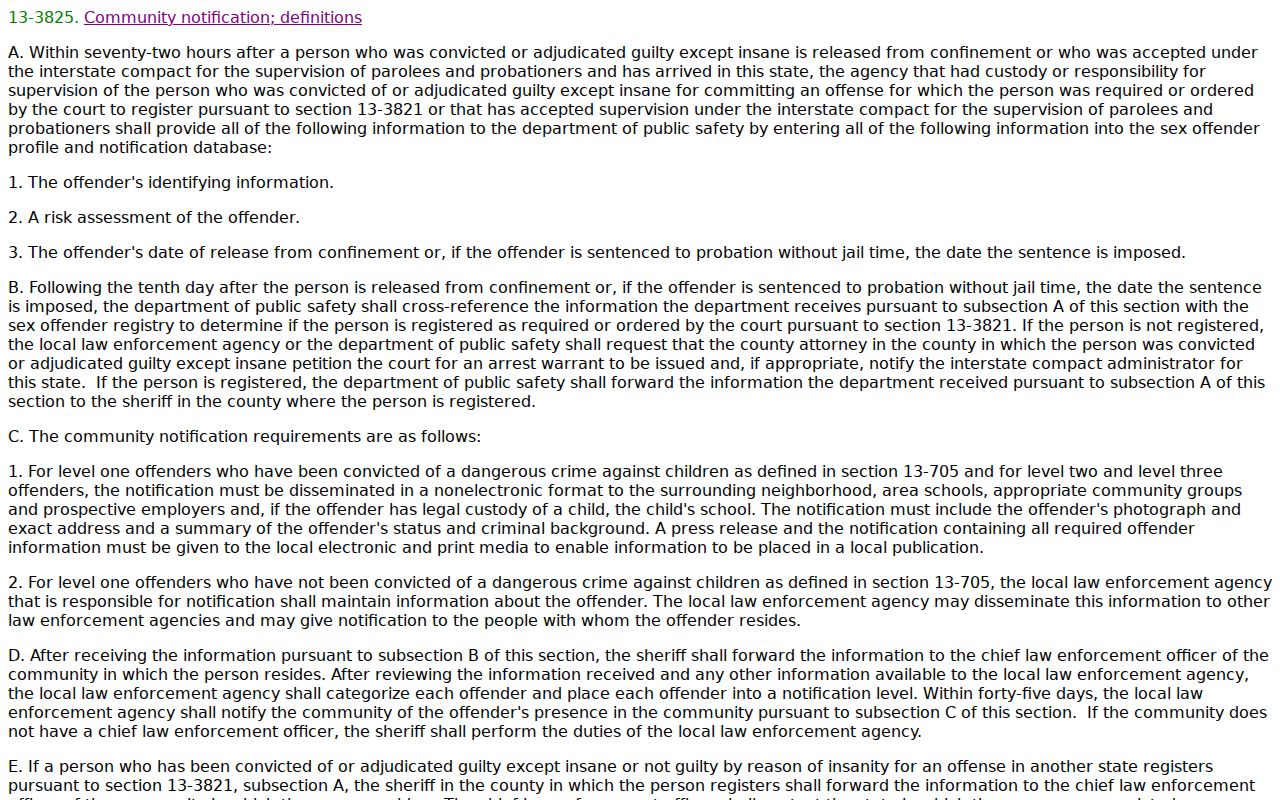
Public visibility can therefore differ for lawful reasons. A missing broad profile is not proof that no registration information exists.
Non-Compliant Mohave Offender Records
OffenderWatch keeps non-compliant searching separate so users can distinguish a published compliance concern from the ordinary result list. The Sheriff's Most Wanted page also includes felony warrants and sex offender registration-compliance warrants. A warrant is a court order, while a non-compliant registry status describes a registration issue. Neither should prompt a user to confront anyone.
The Mohave County Sheriff's Most Wanted page is shown below as an official route for compliance-warrant information.
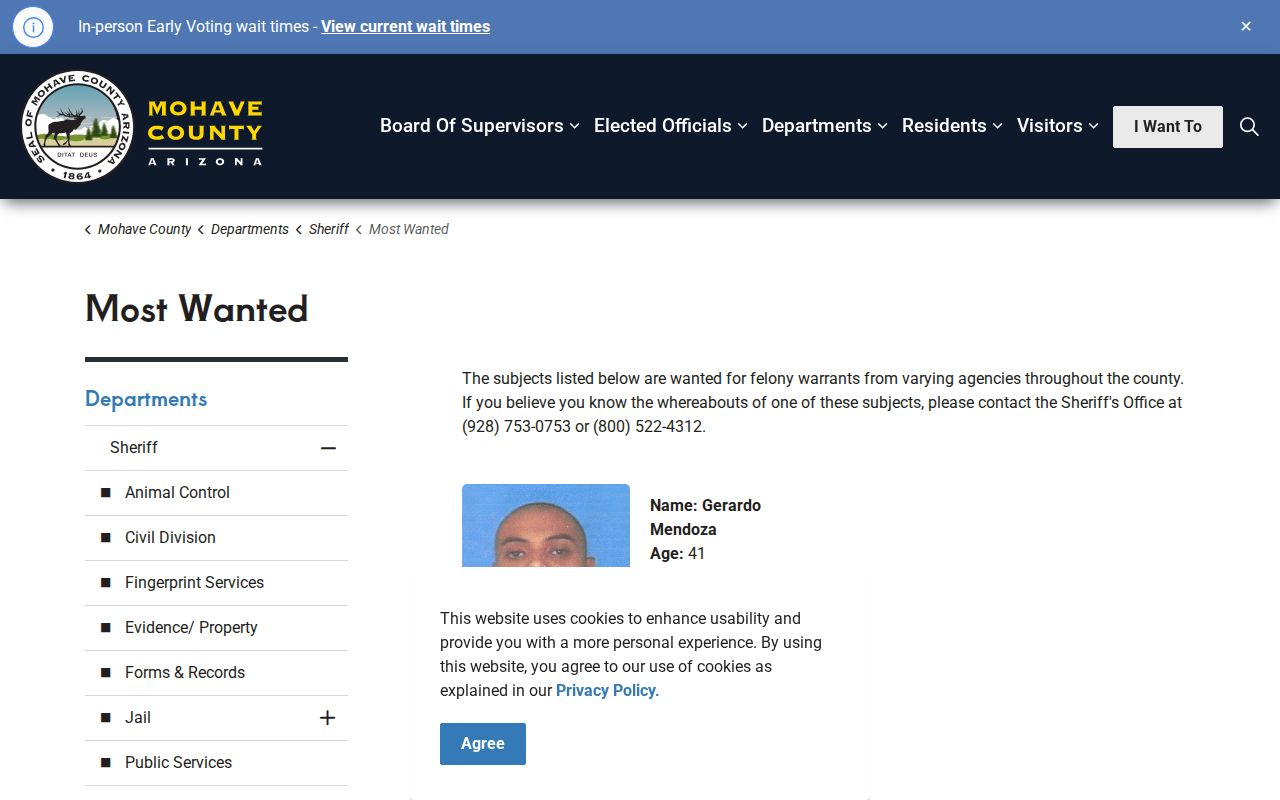
Report an apparent issue to law enforcement. Do not attempt to verify an address or execute a warrant yourself.
Note: The sheriff lists 928-753-0753 and 800-522-4312 for office contact, with 800-526-1911 also shown for registration-compliance information.
Lawful Use and Community Notification
Registry information supports personal, family, and neighborhood safety planning. Use it to learn about a location, choose an alert radius, or give accurate information to law enforcement. Avoid assumptions beyond the public fields. A profile is not a complete court docket, and registration does not establish that a new offense occurred.
Use registry information lawfully: Threatening, intimidating, harassing, harming, or taking unlawful action against a registrant or household may lead to criminal charges. Arizona's community-notification law authorizes awareness, not vigilantism or misuse.
When immediate danger exists, call emergency services. For a possible registration violation, contact the Mohave County Sheriff's Office or the police department with jurisdiction and provide facts rather than confronting the person.